By: Expedited Security and DNSimple.
Why a Guide to Heroku Domains?
Most developers interact with domains infrequently as most programming tasks are more about adding features than registering a new domain and associating it with a site.
Heroku’s documentation is good but tightly focused on the sliver of domain interaction that they’re responsible for: connecting a domain to a single Heroku application.
What is outside of Heroku’s responsibility, but vital to keeping your application secure and performant are a range of domain and DNS configuration options that are too often glossed over.
Domain Basics
Some of the most impactful choices you can make about your domain happen before you’ve even set up your site: what domain go get, where to register it and how to configure DNS all play a part in establishing a strong foundation for your site.
How to Get a “Good” Domain
#### Strategy 1: Bricks of CashRecently Basecamp, makers of…Basecamp, announced that they were going to be launching a new product for email called “Hey”. Working quickly, extremely online folks put together the following Twitter timeline.
If you’re unfamilar with the people above and need to calibrate for what they might consider “difficult” and “expensive”. Just know that DHH personally funds and
#### Strategy 2: Use a Newfangled TLDAs a result of all the .com addresses being taken up by domain “investors”. ICANN has been steadily opening up new top level domains (TLDs) for registration. Such TLDs as:
- .shaw
- .wang
- .venture
- .online
- .lawyer
Which may or may not work for you and comparatively the prices can’t be beat:
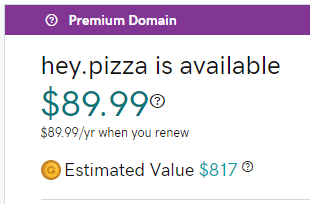
But we generally don’t recommend this strategy as there are still many systems which won’t recognize your domain as “valid” because it doesn’t conform to previous domain standards.
An easily demonstrated example is Slack, which automatically links “.com” URLs but does not link “.cloud” (and many other vanity TLD) domains.
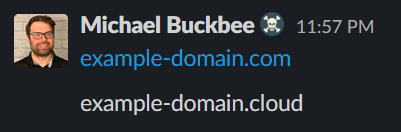
With Slack it’s a minor annoyance, but consider that every single:
- SAAS Service you sign up for
- Email Form Fill
- Organizational Interaction
…that you do is going to perform a similar validation and it’s inevitable that some of them will get it wrong.
#### Strategy 3: Prefixing and Suffixing for ProfitPart of mania for short easy to remember domain names was due to how bad early web search was - you wanted a name people could remember and come back to: the world has changed.
Navigational Searches
Now a significant percentage of Google “searches” are navigational. Millions of people a day type “CNN” into the Google homepage rather than type the URL and the people seeking out your website aren’t going to do any different.
Exact Match Domains Don’t Matter
Similarly, exact match domains used to be given much more weight in search results (they’re now <a href=‘https://www.searchenginejournal.com/do-exact-match-domains-still-work/283759/">deprecated as a ranking factor).
People are also getting more sophisticated with their searches
The upshot of all of this is that you can with little effort secure a very reasonable domain name by taking your “core” word or phrase and adding prefixes and suffixes to it. This method is so effective that even companies that are now dropping huge amounts of money for domains started out doing it.
Looking at you http://BasecampHQ.com (no joke this used to be their domain and it still works).
DNS Glossary
Much like competitive cheerleading or performing open heart surgery, DNS is one of those things that’s hard to just jump in and “do”. You need to understand at least some of the moving pieces or else you’ll take your site offline or paint yourself into a painful metaphorical corner.
“A” Record
DNS records that connect a domain name such as example.com to an IP address 192.168.1.1